











Why "Automation Fit" Deserves as Much Attention as Automation Itself
 Warehouse automation investments frequently exceed seven figures, yet a surprising number of projects stall or underperform after go-live. The reason is rarely inadequecies with the technology itself. Rather the gap between what an automated system can do on paper and what your operation actually demands every shift are very different.
A McKinsey analysis found that many automation deployments fall short of projected returns because organizations skip the stress-testing phase, jumping from business case approval to equipment selection without validating operational fit. That gap is where this guide lives.
In the sections ahead, you'll walk through six categories of operational constraints, from labor and process to space, throughput, systems, and implementation, and learn how to pressure-test your warehouse automation strategy before committing capital. The goal: a strategy that fits your operation.
Table of Contents
What "Stress-Testing" an Automation Strategy Really Means
Stress-testing is a validation discipline. You take a proposed automation plan and run it through the real-world conditions your operation faces, the constraints that don't appear in vendor demos or idealized throughput projections.
Consider the analogy of a flight simulator. Pilots don't wait for turbulence at 30,000 feet to discover how an aircraft responds. They test edge cases on the ground first. Stress-testing your automation strategy follows the same logic: identify the variables that could disrupt performance, model them, and validate before installation begins.
Trew uses a data-driven, collaborative solution development approach built around this principle. The process starts by listening to your business goals, mapping your operational reality, and then designing a solution with the right balance of technology, operational fit, ROI, and time to value.
Constraint 1: Labor Availability and Workforce Readiness
Labor remains the single largest variable in warehouse operations. Low availability, high turnover, and inconsistent skill levels all affect how automation performs once installed.
 Here are the questions to stress-test against this constraint:
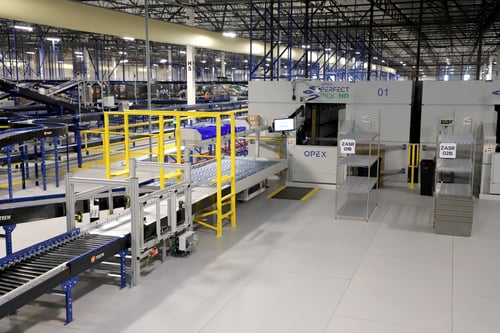
- What is your current turnover rate, and how does it affect training timelines? If you're cycling through associates every 60 to 90 days, your automation must minimize ramp-up time. Solutions like goods-to-person systems reduce walking time and simplify the pick process, lowering training requirements significantly.
- Can your team maintain the equipment you're planning to install? PLC-based controls, like those Trew designs exclusively, are built for long-term maintainability because they use non-proprietary components that your in-house team can service without vendor lock-in.
- What happens during peak-season hiring surges? Your automation should absorb volume spikes without requiring proportional headcount increases. A Warehouse Execution System (WES) like Trew's SmartMoves WX coordinates automated and manual workflows in real time, balancing the load across both.
Caution: the specifics of labor impact vary widely by region, industry, and shift structure. Use these questions as a directional framework, not a prescriptive checklist.
Constraint 2: Process Complexity and Order Profiles
Your order profile dictates which automation technologies are worth evaluating and which ones will create more problems than they solve.
Stress-test your process complexity by examining:
- Average lines per order: Operations handling fewer than five lines per order often benefit from batch picking or goods-to-person solutions. High-line-count orders may need zone-based pick-and-pass configurations with downstream consolidation.
- SKU velocity distribution: If 80% of your picks come from 20% of your SKUs, your slotting and storage approach will look very different than if velocity is evenly spread. Trew designs storage and retrieval strategies around your actual order data, not industry averages.
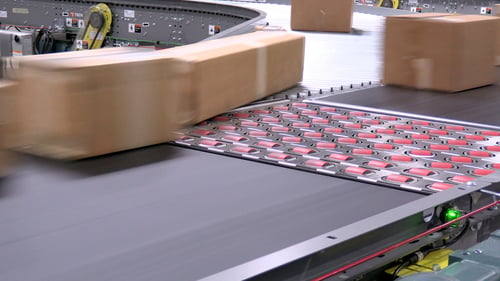
- Item variability: Polybags, jiffys, cartons, and oversized items each behave differently on conveyor and sortation equipment. Trew's TrewSort sortation systems are designed to handle cartons, totes, jiffys, and polybags on the same sorter, accommodating packages as small as a typical cell phone (6 in. x 2 in. x 0.22 in.).
The point here is straightforward: the more varied your process, the more tailored your automation needs to be. A generic solution applied to a complex operation is a recipe for bottlenecks.
Constraint 3: Available Space and Building Layout
Floor space is finite. Ceiling heights vary. Column spacing, dock door locations, and mezzanine configurations all constrain what you can physically install and where.
Key stress-test questions for space:
- Can you model the proposed layout at full throughput? A system that fits on a CAD drawing may not work when you account for staging areas, accumulation zones, and maintenance access paths. Trew's modular approach to conveyor systems gives you flexible layouts that can be reconfigured as your operation evolves.
- Is this a greenfield or brownfield project? Brownfield installations carry additional constraints: existing infrastructure, running operations that can't stop, and legacy equipment that may need integration. Trew has deep experience in both scenarios, applying the same data-driven solution development process whether you're starting from scratch or modernizing an existing operation.
- Have you accounted for accumulation? Accumulation zones buffer variability between upstream and downstream processes. Without adequate accumulation, volume mismatches create bottlenecks. Accumulation is only valuable when it is sized accurately and controlled with intent.
Constraint 4: Throughput Requirements and Growth Projections
Automation should be designed for the throughput you need today and the throughput you'll need in three to five years. Under-specifying creates choke points. Over-specifying wastes capital.
According to Interact Analysis, the warehouse automation market continues to broaden, with more operations investing in scalable solutions that match evolving order profiles and throughput demands.
 Stress-test throughput by asking:
- What are your peak-day requirements versus your average day? If peak is three to four times your daily average, your system design must handle those spikes without degrading accuracy or creating backlog. Trew designs sortation solutions rated from under 45 cartons per minute (CPM) for lower-throughput applications up to 350+ CPM for high-speed operations.
- Where are your current bottlenecks? Sortation bottlenecks can impact the entire operation if not addressed in the design phase. Identifying these choke points early lets you right-size divert destinations, merge configurations, and accumulation zones.
- Does your growth plan require modular scalability? The TrewSort Swivel Wheel sorter, for example, uses a modular SmartRow design that supports independent control of each wheel row, so you can expand throughput without replacing the entire sorter.
Throughput planning also needs to account for system recovery after outages. Trew's 24/7 technical support and field service teams help operations recover quickly from unplanned downtime, keeping your throughput targets on track.
Constraint 5: Systems Integration and Software Architecture
Automation hardware is only as effective as the software directing it. If your WMS, ERP, or host system can't communicate with your material handling equipment in real time, performance gaps are inevitable.
Here's how to stress-test your systems integration readiness:
- How many interface points exist between your business systems and the automation layer? Every interface is a potential failure point. Trew's CHAMP WCS simplifies control system architecture by communicating directly with host systems, system I/O, and PLCs, reducing interface points of failure and streamlining data handling.
- Do you have real-time visibility into system performance? CHAMP WCS delivers real-time system status with graphical views, alarm notifications, and detailed I/O diagnostics so your operations and maintenance teams can identify issues before they cause downtime.
- Can your software layer coordinate both automated and manual workflows? If the answer is no, you'll need a WES. Trew's SmartMoves WX orchestrates warehouse operations, from order processing through pick, pack, and ship, across automated and manual processes in a single platform.
Makes sense, right? Yet many operations invest in physical automation without validating whether their software stack can keep pace. Integration testing should happen before equipment hits the floor, not after.
Constraint 6: Implementation Risk and Time to Value
Implementation is where automation strategies either validate or collapse. Budget overruns, missed go-live dates, and scope creep are common failure modes, and most of them trace back to insufficient planning during the design phase.
Stress-test your implementation plan by evaluating:
- Is there a detailed project plan with defined milestones, risk mitigation steps, and testing protocols? Trew's approach includes thorough testing, validation plans, and on-site go-live support built into every project to reduce risk and manage gaps.
- Have you planned for phased deployment? Rolling out automation in phases minimizes operational disruption and lets you validate performance at each stage before expanding. Trew's Customer Experience (CX) services extend through startup, operational coaching, and post go-live engagement.
- What does your post go-live support model look like? The value of your investment isn't just measured at go-live. It's measured across the system's full lifecycle. Trew backs every installation with 24/7 technical support, resident maintenance staffing options, customized training, system assessments, and spare parts management to maximize lifetime value.
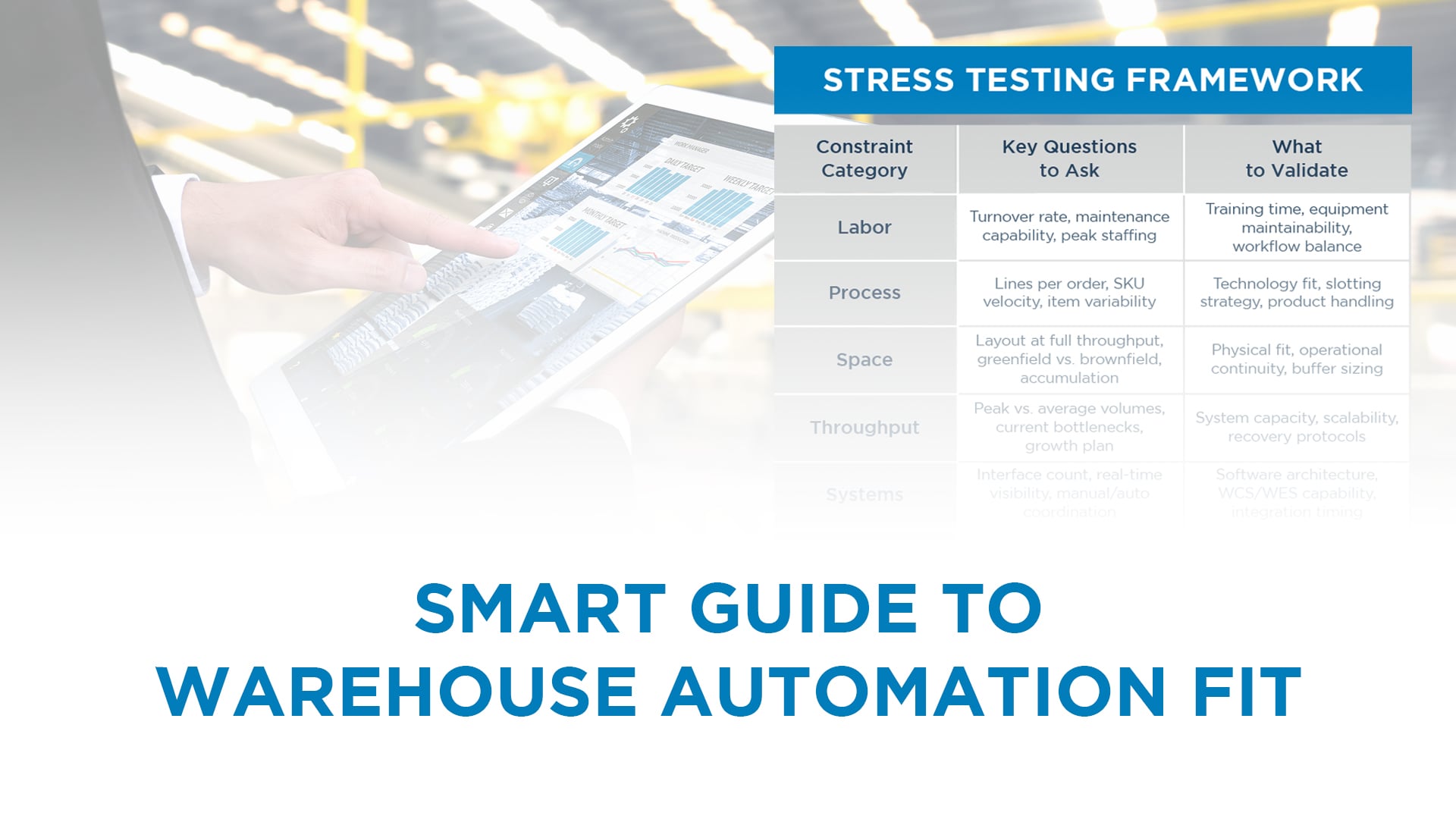
How to Build Your Stress-Testing Framework
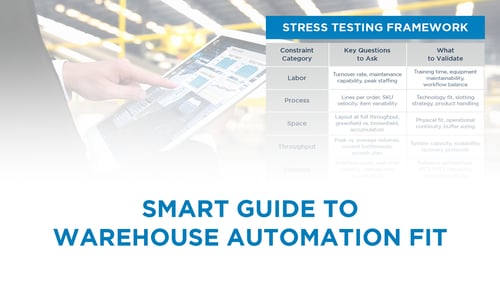
The six constraints above form a repeatable framework you can apply to any automation investment decision. Here's a summary of how to put it into practice:
| Constraint Category | Key Questions to Ask | What to Validate |
|---|---|---|
| Labor | Turnover rate, maintenance capability, peak staffing | Training time, equipment maintainability, workflow balance |
| Process | Lines per order, SKU velocity, item variability | Technology fit, slotting strategy, product handling |
| Space | Layout at full throughput, greenfield vs. brownfield, accumulation | Physical fit, operational continuity, buffer sizing |
| Throughput | Peak vs. average volumes, current bottlenecks, growth plan | System capacity, scalability, recovery protocols |
| Systems | Interface count, real-time visibility, manual/auto coordination | Software architecture, WCS/WES capability, integration timing |
| Implementation | Project milestones, phased rollout, post go-live support | Risk mitigation, testing plans, lifecycle services |
Let's talk about how to apply this to your specific operation. Trew starts every engagement by listening first, then uses a collaborative blueprinting process to map your constraints, model your data, and design a solution tailored to your business goals.
Frequently Asked Questions
What is the most common reason warehouse automation projects underperform?
Misalignment between the automation design and the operation's actual constraints is the top driver of underperformance. This includes mismatches in throughput expectations, inadequate software integration, and insufficient planning for labor variability. Stress-testing your strategy against real operational conditions before committing capital significantly reduces this risk.
How do I know if my operation is ready for automation?
Readiness depends on several factors: order volume and growth trajectory, labor availability, SKU complexity, and your current system architecture. If your operation is facing persistent bottlenecks, rising labor costs, or difficulty meeting service-level commitments, automation may be a strong fit. Trew's solution development process starts with a thorough assessment of these factors before recommending any technology.
Should I choose a WCS or a WES for my operation?
A Warehouse Control System (WCS) manages real-time equipment routing and control at the machine level. A Warehouse Execution System (WES) adds inventory coordination, order management, and workflow orchestration on top of that. If your operation needs to coordinate both automated equipment and manual labor across multiple processes, a WES like Trew's SmartMoves WX is the right fit. If your primary need is equipment-level control and host integration, a WCS like CHAMP may be more appropriate.
How does Trew handle brownfield automation projects differently than greenfield?
The solution development approach is fundamentally the same for both: define the right balance of technology, operational fit, ROI, and time to value. Where brownfield projects differ is in the constraints. Existing infrastructure, running operations, and legacy equipment all add complexity. Trew uses PLC-based controls and a modular approach specifically to simplify integration with existing systems, reduce points of failure, and support phased modernization.
What kind of post go-live support should I expect from an automation partner?
Your automation partner should offer ongoing support that matches the criticality of your operation. Trew delivers in-house 24/7 technical support, expert field service technicians, resident maintenance staffing, customized training, system assessments for lifecycle planning, and a dedicated parts fulfillment center so you can avoid unplanned downtime through spare parts availability.
Building an Automation Strategy That Fits Your Operation
The difference between an automation investment that delivers and one that disappoints usually comes down to one thing: how thoroughly the strategy was tested against your operational reality before equipment was ordered.
By pressure-testing your plan across labor, process, space, throughput, systems, and implementation constraints, you reduce risk, protect your capital, and set the stage for performance that holds up over the long term.
Trew brings experienced industry practitioners, integrated hardware and software, and a collaborative process that starts with listening to help your operation run smarter, adapt faster, and reach its highest lifetime value.